
Your offer is accepted, the inspection period starts, and then the insurance quote stalls. The reason is often a four-point inspection, and the two items I see cause the biggest surprises are the roof and the plumbing. Here's what that inspection is, why it matters in Florida, and how a deal can stay alive when it turns something up.
What a four-point inspection is (and isn't)
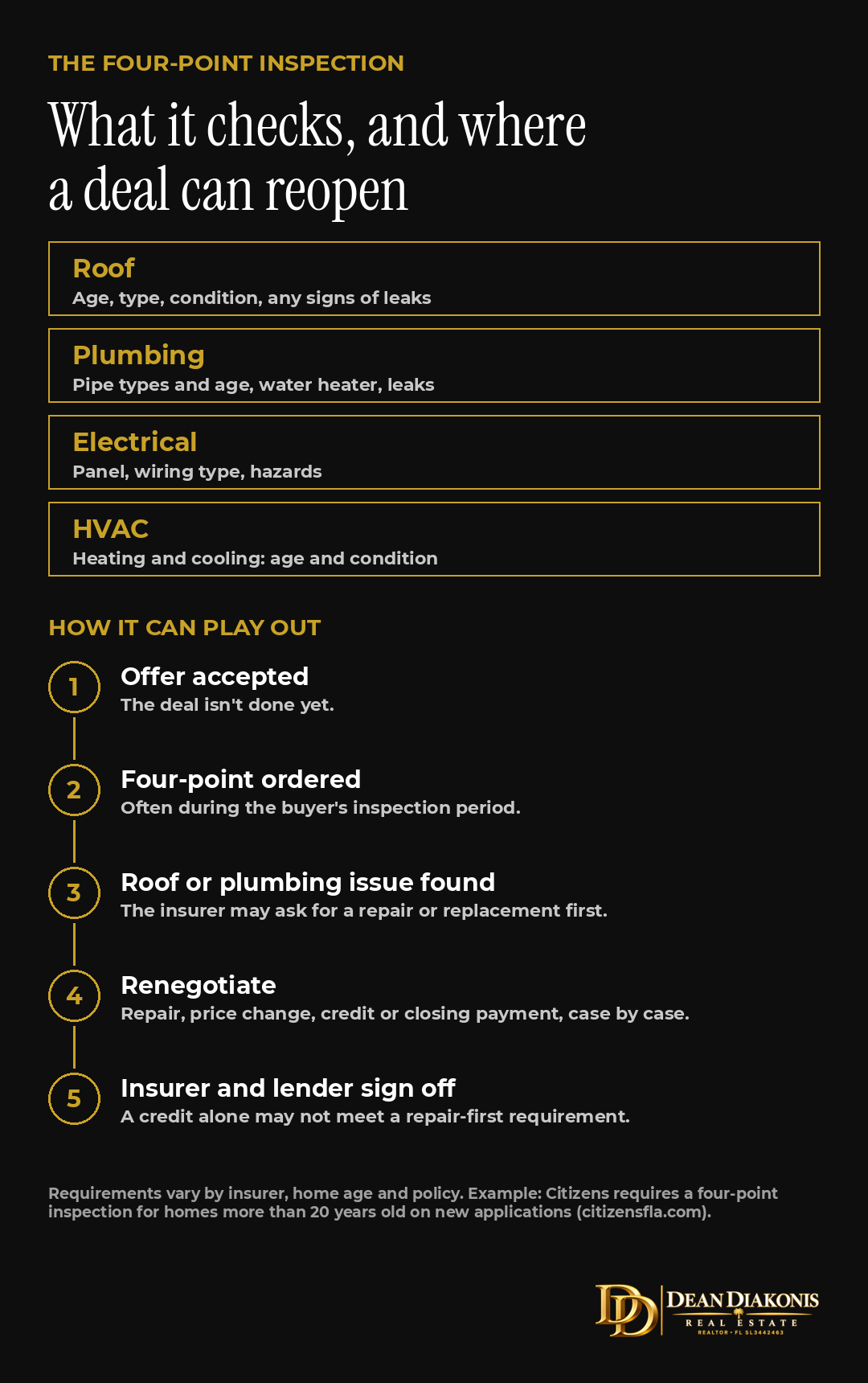
A four-point inspection is an insurance inspection. It looks at four systems: the roof, plumbing, electrical and HVAC. A licensed inspector records the age, type and condition of each. Citizens Property Insurance, for example, says the inspector must provide the age, type and condition of the wiring, heating and plumbing systems, and roof. Its current form also asks for details such as pipe types, the age of the water heater and supply piping, whether the home was re-piped, and any visible signs of roof leaks (Citizens form update, March 2025).
It is not a full home inspection. A general home inspection is something you order for your own information. It covers much more of the house, and the report goes to you. A four-point is narrower and is used by an insurance company to decide whether, and on what terms, it will write a policy.
When it's required
There is no single rule for every home. Each insurer sets its own underwriting rules. Some examples from official sources:
- Citizens requires a four-point inspection for property owner, dwelling and mobile home applications on homes more than 20 years old. The report must be dated within the last 12 months. For new policies it says serious hazards or deficiencies, such as exposed wiring or active leaks, "should be repaired before an application for coverage is submitted."
- Older roofs at Citizens: shingle-type roofs older than 25 years, or tile and metal roofs older than 50, need documentation of at least five years of remaining useful life. Otherwise the roof must be replaced before a policy is written.
- Florida law: under section 627.7011(5), Florida Statutes, an insurer can't refuse to issue or renew a homeowners policy solely because a roof is under 15 years old. For older roofs, it must let the homeowner get an inspection first. If that inspection shows at least five years of useful life left, the insurer can't refuse solely on roof age. Insurers can still decline for other lawful reasons.
Private insurers have their own rules, which change. If the buyer is financing, the lender needs proof of insurance before closing. That's why a four-point problem can quickly become a closing problem.
Roofs: expected, but still a surprise
On an older home, a roof near the end of its life shouldn't shock anyone. The surprise is usually the timing, finding out in the middle of a contract that a carrier won't write the policy until the roof is replaced.
When I'm listing an older home, my preference is to replace the roof before it goes on the market, if that's feasible. A new roof is a strong selling point, and it takes the issue off the table. When that isn't practical, the options are worked out case by case: a price adjustment, the seller paying for the replacement at closing, or a seller credit. One caution: a credit or price cut doesn't satisfy an insurer that wants the work done before it binds coverage. Whatever you agree to has to work for the buyer's insurer and lender.
Plumbing: the costlier surprise
Plumbing tends to be the more expensive surprise, because it's harder to see. Older or problem pipe materials, leaks, or an aging water heater can mean repairs or re-piping, and that work can be required before some insurers or loans will move forward. Repairs that aren't visible from a showing are exactly why the inspection period matters.
An accepted offer isn't the finish line
A four-point surprise doesn't have to end a deal. In my experience it often just reopens the negotiation. Buyer and seller can agree on repairs, a price change or a credit, as long as the insurer and lender can accept it. Sellers who expect this can get ahead of it with a pre-listing inspection, to reduce the chance of discovering major problems for the first time with a buyer under contract.
If you're selling an older home, I can help you decide whether to inspect or repair before listing. Start with a home valuation or see how I work with sellers. If you're buying, browse homes for sale across Tampa Bay, and talk to an insurance agent early in your inspection period.
This article is general information, not insurance or legal advice. Requirements vary by insurer and policy and can change.