Mortgage rates have come down four weeks in a row. Freddie Mac's survey had the average 30-year fixed at 7.11% for the week of Nov. 12, 2026, down from 7.40% in the middle of October. That's good news. It's also still almost a full point higher than a year ago, when the same survey sat at 6.24%.
So I'm getting two questions right now. Buyers want to know what a payment actually looks like at these rates. Sellers want to know whether to cut the price or offer something else. The answer to both comes down to the same math, so let's do it.
Where rates actually are
Freddie Mac's Primary Mortgage Market Survey is the national weekly average most news stories quote. The latest numbers, published Nov. 12, 2026:
- 30-year fixed: 7.11%, down from 7.18% the week before and from 7.40% on Oct. 8 and Oct. 15, the highest readings this year.
- 15-year fixed: 6.45%, down from 6.57% the week before.
- A year ago: 6.24% on the 30-year and 5.49% on the 15-year.
- This year's low: 5.98% on Feb. 26, 2026, per the weekly history on FRED.
Two things to keep in mind. This is a national average for conventional purchase loans, and Freddie Mac says the borrower profile behind it is good-to-excellent credit with 20% down. Your rate depends on your credit, down payment, loan type and points. And it updates every Thursday at noon Eastern, so check the current week before you lean on any number here.
What that means for a Tampa Bay payment
For a realistic example, I used $385,000. That's Realtor.com's median list price for the Tampa metro in October 2026, which covers Hillsborough, Pinellas, Pasco and Hernando counties. It's an asking price, not a sale price, but it's a fair middle-of-the-market number.
With 10% down, that's a $346,500 loan on a 30-year fixed. Here's the monthly principal and interest at the rates above:
- At 5.98% (February's low): about $2,073 a month
- At 6.24% (a year ago): about $2,131
- At 7.11% (now): about $2,331
- At 7.40% (October's high): about $2,399
So the drop since October is worth about $68 a month on this loan. Compared with a year ago, the same house costs about $200 a month more in principal and interest. On this loan, every quarter point is roughly $58 a month.
That's not your whole payment. Property taxes, homeowners insurance, flood insurance if you need it, HOA dues and mortgage insurance (with less than 20% down on a conventional loan) all come on top, and in Florida those can add up to a big chunk. Plug your own numbers into my mortgage calculator to see the full picture on a specific home.
Price cut or rate buydown? Run the numbers
This is the part I want sellers to read. A lot of sellers respond to a slow market by cutting the price. That's often the right call. I've written about price cuts outrunning new listings in Tampa Bay. But when rates are high, a price cut doesn't move the buyer's monthly payment much.
On the same $385,000 home with 10% down at 7.11%:
- A $10,000 price cut lowers the loan by $9,000 and the payment by about $61 a month. The buyer also puts down $1,000 less.
- A 2-1 temporary buydown paid by the seller lowers the buyer's rate by 2 points in year one and 1 point in year two, then it goes back to the full rate. On this loan that's about $447 a month less in year one and about $229 a month less in year two. It costs roughly $8,100, which is the total of those monthly differences.
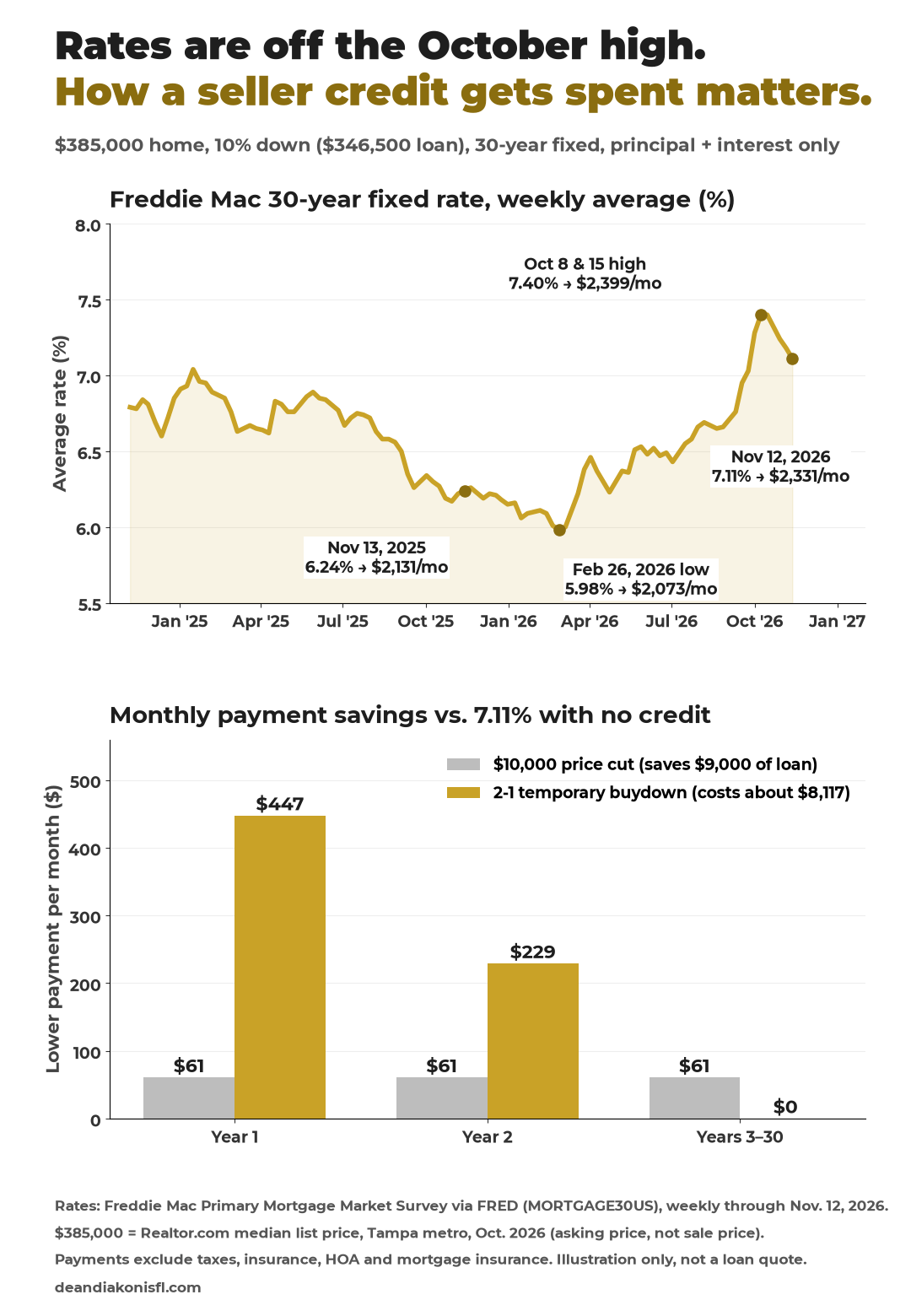
So the seller spends less than the price cut, and the buyer gets a much lower payment for the first two years. The trade-off is that the price cut lasts all 30 years and the buydown doesn't. By year three the buyer is paying the full $2,331. For a buyer who expects their income to grow, or who's planning to refinance if rates fall, the buydown can make more sense. For a buyer who's stretched today and will still be stretched in three years, it's a short-term fix.
A permanent buydown, where the seller pays discount points to lower the rate for the life of the loan, is a third option. What a point buys changes daily and varies by lender, so get that quote in writing from the buyer's lender before anyone agrees to anything.
The rules that limit seller credits
Seller money isn't unlimited. On conventional loans sold to Fannie Mae, the interested party contribution limits for a primary residence or second home are:
- 3% of the price when the buyer puts down less than 10%
- 6% with 10% to 25% down
- 9% with more than 25% down
A seller-paid buydown counts toward that cap, along with any closing cost credit. In my example, 6% of $385,000 is $23,100, so a roughly $8,100 buydown fits with room left for closing costs. Fannie Mae also requires the credit not to exceed the buyer's actual closing costs; anything over is treated as a price reduction.
Under Fannie Mae's temporary buydown rules, the lender has to qualify the buyer at the full note rate, not the bought-down rate. A buydown helps cash flow; it doesn't help a buyer qualify for more house. The buydown can last no more than three years, and the rate can step up no more than 1 point a year. The buydown agreement also spells out what happens to unused funds if the loan is paid off early, like in a refinance, so read it.
FHA and VA loans have their own limits. VA caps seller concessions at 4%, which I covered in my VA loan guide for Tampa Bay. Ask your lender which rules apply to your loan before you write the offer.
What I'd do right now
- Buyers: Get your payment quoted at today's rate, not the rate you're hoping for. If a home has been sitting, ask about a seller-paid buydown instead of only fighting over price. And make sure you're comfortable with the full payment in year three.
- Sellers: Before you cut the price again, ask what the same money would do for a buyer's payment. A credit toward a buydown can make your house look cheaper per month than the house down the street that took a bigger price cut.
- Everyone: Rates moved more than a full point this year. Don't build a plan around next month's rate. Build it around a payment you can live with today.
Sources
- Freddie Mac, Primary Mortgage Market Survey, results as of Nov. 12, 2026, and FAQ on borrower profile and release schedule. Retrieved Nov. 17, 2026.
- Freddie Mac weekly 30-year and 15-year fixed rate history via FRED, Federal Reserve Bank of St. Louis: MORTGAGE30US, MORTGAGE15US. Retrieved Nov. 17, 2026.
- Realtor.com Housing Inventory, Median Listing Price, Tampa-St. Petersburg-Clearwater, FL (CBSA), October 2026, via FRED.
- Fannie Mae Selling Guide: B3-4.1-02, Interested Party Contributions and B2-1.4-04, Temporary Interest Rate Buydowns.
- Payment figures are standard 30-year amortization of principal and interest calculated from the rates above. They're illustrations, not loan quotes or a commitment to lend.
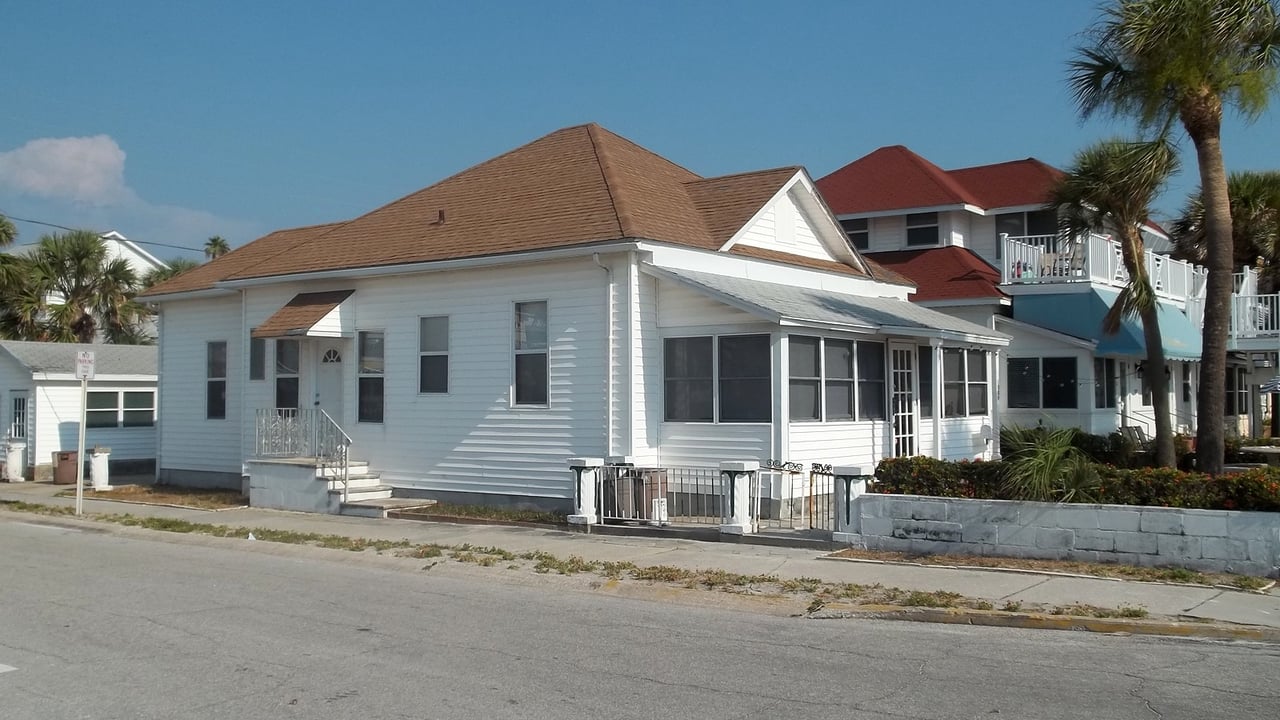
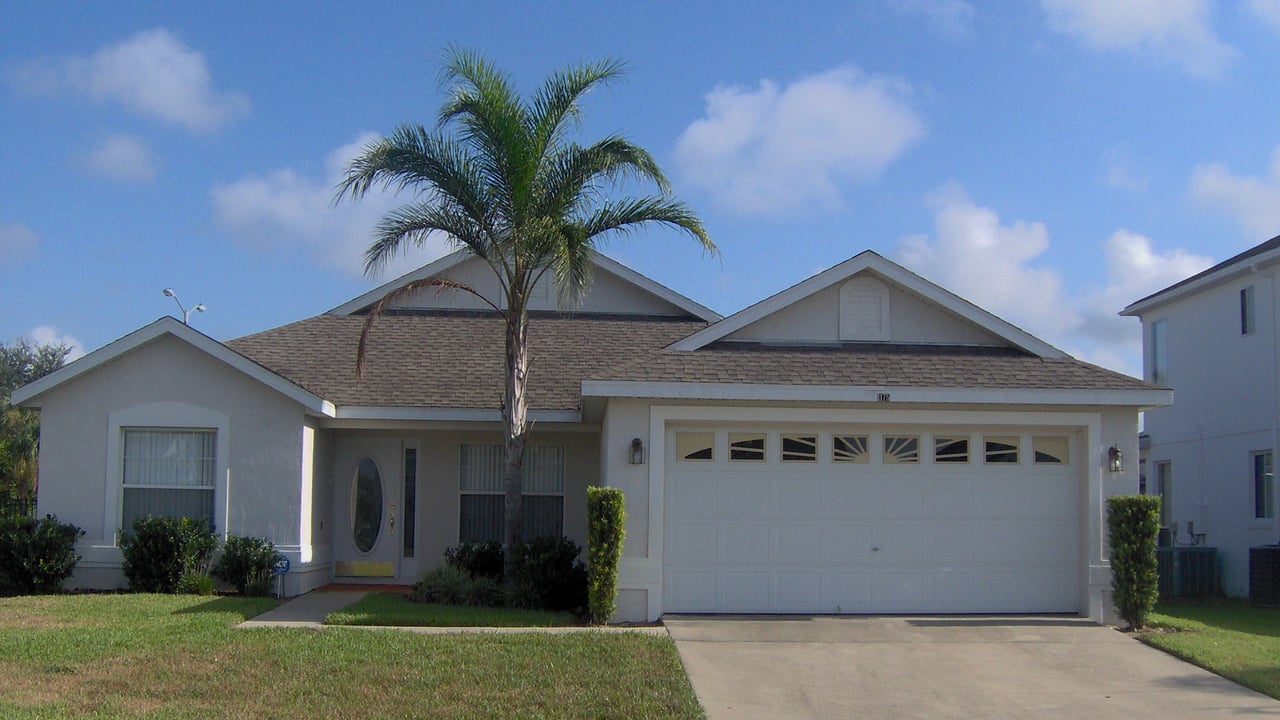
Featured photo: "Amrican house" (typical house in Florida) by מתניה (Matanya), CC BY-SA 3.0, via Wikimedia Commons, cropped and lightly darkened. This article is general information, not lending, legal or tax advice.