If you own a Tampa Bay rental, an investment home or a second home that doesn't have a homestead exemption, here's the short version: Amendment 3 lowers the annual cap on assessed-value increases for that property from 10% to 5% beginning January 1, 2027, for every levy except school taxes. The Florida Department of Revenue confirmed it in a bulletin on November 5, and it first applies to the 2027 tax roll.
What it doesn't do is cap your tax bill at 5%, cut your school taxes, or follow the property to the next owner. Those are the parts people mix up, so that's where most of this post goes. If the place you're asking about is your homestead, my post on what Amendment 3 means for Tampa Bay homeowners covers the bigger exemption. This one is for everything else.
What actually changed for non-homestead property
The Pinellas County Property Appraiser puts it plainly: a non-homestead property is any property that does not receive a homestead exemption. Their examples are rental property, commercial property, second homes and vacant land. Your winter place, your duplex and the old house you kept as a rental all count.
For those properties, the change is one number. The Department of Revenue's bulletin PTO 26-21 says Amendment 3 "reduces the annual cap on assessment increases for non-homestead properties from 10% to 5%," and that it "takes effect January 1, 2027, and first applies to the 2027 tax roll."
The constitution handles this in two subsections: one for non-homestead residential property with nine units or fewer (most single-family rentals, condos and duplexes), and one for other property, like commercial buildings. The amended text gives both the same schedule for levies other than school district levies: 10% before January 1, 2027, and 5% beginning January 1, 2027. Both also keep the same rule that "no assessment shall exceed just value."
What the 5% cap does not do
Four things the headlines skip:
- It caps assessed value, not your tax bill. The 5% limits how much the assessed value used for non-school taxes can rise in a year. Your bill still depends on the millage rates your county, city and other taxing authorities set, and those can go up or down. Pinellas County's FAQ answers "would the amendment reduce taxes on non-homestead property?" with "Not necessarily."
- School taxes aren't capped. The cap only applies to non-school levies. On non-homestead property, school taxes stay uncapped and are based on just, or market, value. Pinellas, Hillsborough and Pasco explainers all say so.
- Fees aren't covered. CDD fees, stormwater, garbage and other non-ad valorem assessments are separate charges on your bill. They aren't based on assessed value, so the cap doesn't touch them.
- Your 2026 bill doesn't change. The bill that showed up this month is for 2026, and it's due the same as always. If you're deciding when to pay it, I walked through the 4% November discount on Tampa Bay property tax bills.
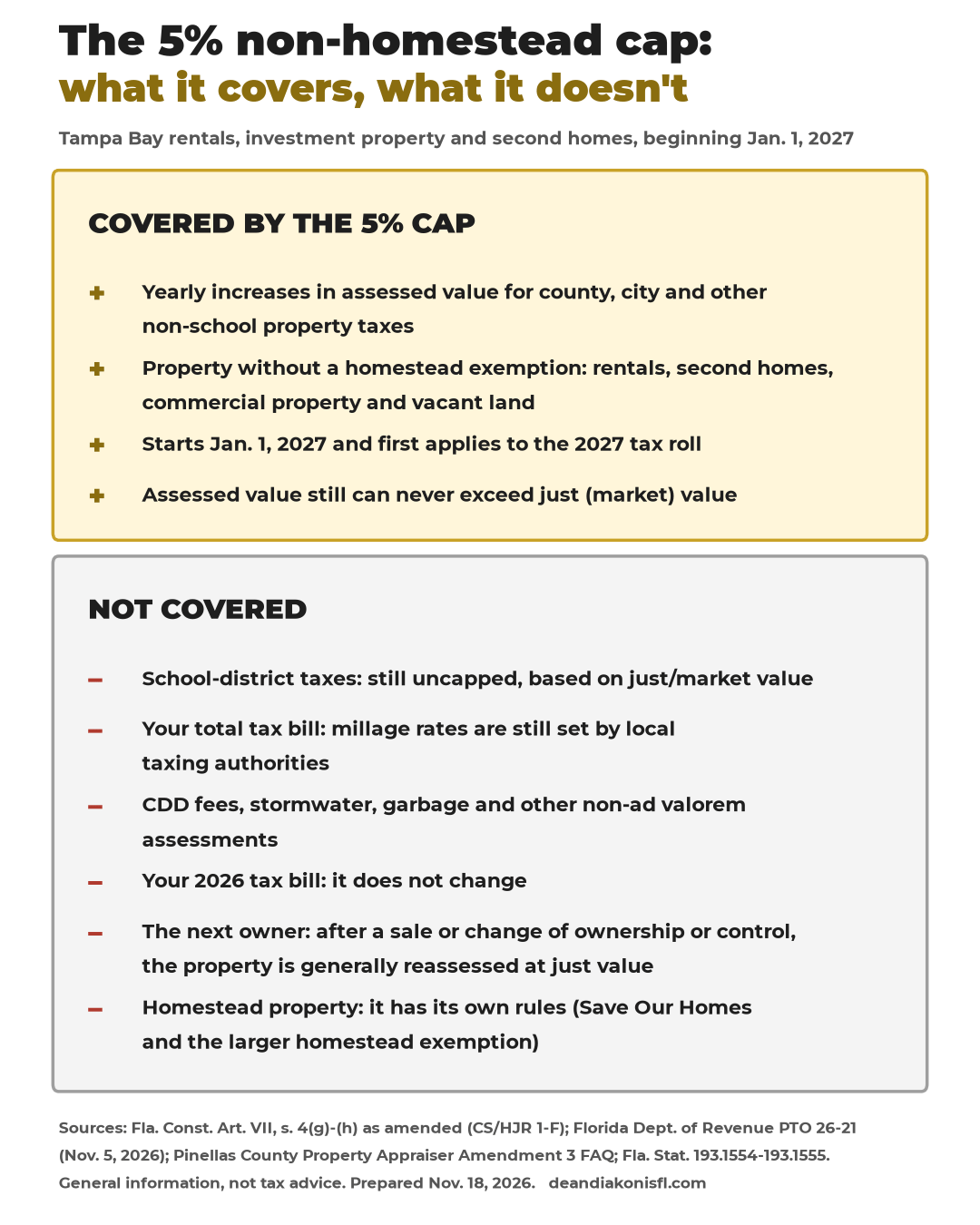
The 5% cap limits assessed-value growth for non-school taxes. It doesn't cap the bill. Sources: Florida DOR PTO 26-21, Fla. Const. Art. VII, s. 4(g)-(h) as amended, Pinellas County Property Appraiser Amendment 3 FAQ, Fla. Stat. 193.1554-193.1555.
When it will show up on a Tampa Bay tax bill
The amendment takes effect January 1, 2027, the assessment date for the 2027 tax roll. Expect your first look on the proposed property tax (TRIM) notice in August 2027, and the first bills reflecting the change in November 2027.
That's the timing the Pinellas and Pasco explainers give, though each county mails its own notices. The Volusia County Tax Collector (not a Tampa Bay county) agrees in its Amendment 3 handout: changes are "first reflected in tax bills mailed in November 2027."
Some details are still being worked out. The Department of Revenue says rulemaking, form updates and more guidance are coming. And the 2026 statutes that run the cap, sections 193.1554 and 193.1555, still say 10%. The constitution now says 5% starting in 2027, so don't read the old statute number as the rule. Expect some cleanup from Tallahassee.
A simple example of how the cap works (illustrative only)
This is an illustration, not a forecast and not a claim about any Tampa Bay parcel or tax bill.
Say a non-homestead property's assessed value for non-school levies is $400,000 on the 2026 roll, and its just (market) value is well above that.
- Under the new rule, the most that assessed value can rise for 2027 is 5% of the prior year, so it can't go above $420,000, unless a reset applies or just value is lower.
- Under the old 10% cap, the ceiling would have been $440,000.
- If just value only rose to $410,000, assessed value couldn't go above $410,000, because no assessment can exceed just value. In that case the 5% cap doesn't do anything.
School taxes are still based on just/market value, and the bill still depends on millage rates and non-ad valorem charges. That's why I'm not turning the gap between those ceilings into a "savings" number. There's no honest way to do that for a property I haven't seen, on a roll that hasn't been built.
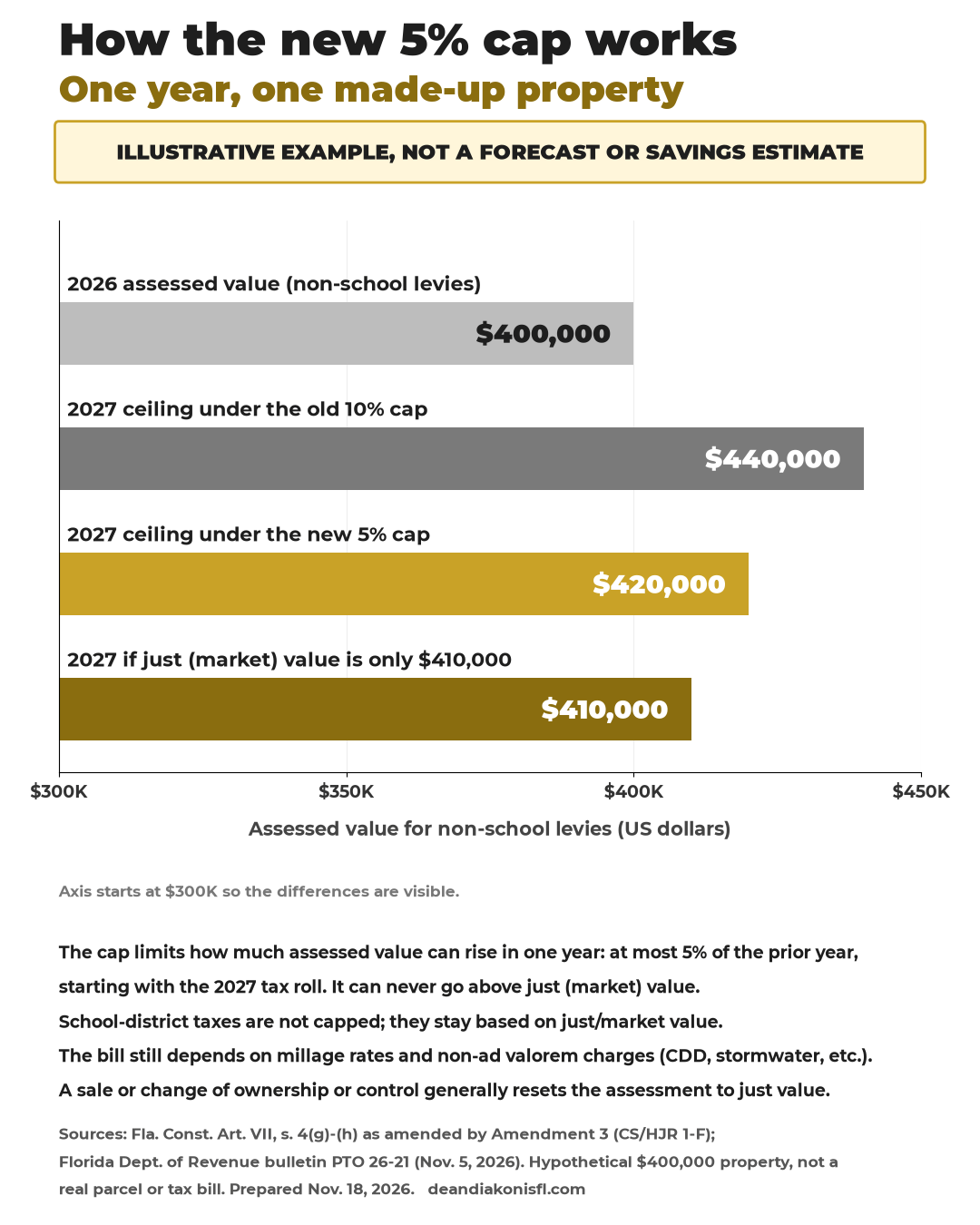
Illustrative example only, not a forecast, tax estimate or savings figure, and not a real parcel. Applies to non-school levies; school taxes stay on just/market value. Sources: Fla. Const. Art. VII, s. 4(g)-(h) as amended by Amendment 3; Florida DOR bulletin PTO 26-21.
What happens when you buy, sell or change control
This is the part that matters most if you're buying. The cap protects the current owner. It doesn't transfer. For residential property with nine units or fewer, the amended constitution says that after a change of ownership or control, the property "shall be assessed at just value as of the next assessment date." Sections 193.1554 and 193.1555 already reset the assessment to just value as of January 1 of the year after a change of ownership or control, and 193.1555 also resets after an improvement that raises just value by at least 25%.
So if a seller has owned a rental for years and their assessed value is well below market, that gap generally goes away when you buy it. The cap only limits increases from the reset value.
- If you're buying: budget taxes from the price you're paying, not the seller's current bill. Their bill reflects years of capped increases. Yours won't.
- If you're selling: expect a careful buyer, and their lender, to do the same math. Your low tax bill is nice to own. You can't hand it over.
- If you own through an LLC or other entity: a change of ownership of the entity that owns the property can also count, as defined by general law. Confirm your setup with the property appraiser or a qualified professional before you move anything around.
One caution: turning your homestead into a rental can change its homestead status. Check with the property appraiser instead of assuming the larger exemption still applies.
How this differs from the homestead side of Amendment 3
- Homestead owners mainly get a larger exemption from non-school taxes, and keep Save Our Homes.
- Non-homestead owners don't get that exemption. They get the tighter assessment cap.
If you live in one house and rent out another, each follows its own rules. For the homestead details, including the exemption schedule and the rule for people who become Florida residents after Dec. 31, 2026, read What Florida's Amendment 3 Means for Tampa Bay Homeowners.
How to check your parcel in Hillsborough, Pinellas and Pasco
You don't need a calculator for this. You need your parcel record. Look it up on your county property appraiser's site and check three things:
- Whether it has a homestead exemption. If not, the 5% cap is your part of Amendment 3.
- Its just (market) value.
- Its assessed value for non-school taxes. If that's well below just value, the cap has been holding it down, and a sale would generally reset it.
Where to look:
- Hillsborough:Hillsborough County Property Appraiser. Its November 4 statement says the office will implement the amendment and share updates.
- Pinellas:Pinellas County Property Appraiser. Its Amendment 3 FAQ is the clearest official explainer I've found. Some of it is still worded from before the vote, but the cap facts match what passed.
- Pasco: Pasco County Property Appraiser (pascopa.gov). As of November 18, 2026, I didn't find a dedicated Amendment 3 page on the appraiser's site. Pasco County's budget office has an Amendment 3 education page with the same cap facts.
What to do if you're holding, buying or selling
- Holding: confirm the property's homestead status, read your August 2027 TRIM notice when it comes, and don't budget around a savings number from a headline.
- Buying: underwrite taxes on the price you're paying, assuming a reset after closing, and remember school taxes run on market value no matter what. Price insurance too. If the property is on Citizens, read my post on the 2027 flood insurance requirement.
- Selling: expect buyers to ask what the taxes will be for them, not what they are for you.
Buyers can start with my buyer's guide or search every Tampa Bay home for sale. Sellers, see my seller's guide or get a home valuation. And if you want help thinking through holding costs on a specific property, get in touch.
Questions people ask
What does Amendment 3 change for Florida rental, investment and second-home owners?
If you own Tampa Bay property that doesn't qualify for a homestead exemption, such as a rental, an investment property or a second home, Amendment 3 lowers the annual cap on assessed-value increases from 10% to 5% beginning January 1, 2027, for levies other than school district levies. The Florida Department of Revenue confirmed it in bulletin PTO 26-21, and it first applies to the 2027 tax roll. You don't get the larger homestead exemption on that property. The tighter cap may slow how fast assessed value rises in a strong market, but it isn't a promise that your bill will fall.
Does the new 5% cap lower my property tax bill?
Not necessarily. The 5% is a cap on how much assessed value can rise in a year for non-school taxes, not a cap on the bill. School taxes on non-homestead property stay uncapped and are based on just, or market, value. Local taxing authorities still set millage rates, and separate charges like CDD, stormwater or garbage assessments aren't covered by the cap. If values are flat, the cap may not change anything. Check your parcel with your county property appraiser instead of assuming a savings number.
When does the cap start, and will it show up on my 2026 tax bill?
Your 2026 bill doesn't change. The lower cap takes effect January 1, 2027, and first applies to the 2027 tax roll. Expect to see it first on August 2027 TRIM notices and on tax bills mailed in November 2027, though each county mails its own.
What happens to the cap when I buy or sell the property?
The lower cap doesn't travel with the property to a new owner at the old assessed value. After a change of ownership or control, non-homestead property is generally assessed at just value again as of the next assessment date, and the cap only applies to later annual increases, up to just value. If you're buying, budget taxes from the value you're paying, not from the seller's current bill. If you're selling, expect a careful buyer to do the same.
How is this different from the homestead changes in Amendment 3?
Homestead owners get a larger exemption from non-school taxes and keep Save Our Homes. Non-homestead owners, including rentals and second homes, don't get that exemption. What changes for them is the annual assessment cap, which drops from 10% to 5% for non-school levies starting with the 2027 roll. For the homestead side, see What Florida's Amendment 3 Means for Tampa Bay Homeowners.
Do school taxes, CDD fees or other non-ad valorem assessments get the 5% cap?
No. The 5% cap only applies to the assessed value used for non-school taxes. School taxes on non-homestead property stay uncapped and based on just/market value. CDD, stormwater, garbage and other non-ad valorem assessments are separate charges, and the cap doesn't apply to them.
The bottom line
The 5% cap is real, and over time it can keep a rental's or second home's assessed value from climbing as fast in a hot market. But it covers one part of your bill, it doesn't touch school taxes or fees, and it resets when the property sells. Plan around those three facts and look at your own parcel.
This article summarizes publicly available Florida Department of Revenue, constitutional, statutory, and county property-appraiser materials. It is general information for Tampa Bay readers, not legal, tax, or accounting advice for any property or person. It is not tax advice. Confirm how the rules apply to your parcel with your county property appraiser (Hillsborough, Pinellas, or Pasco, depending on where the property is), and with a qualified tax professional, before you make decisions.
Sources
- Florida Department of Revenue, Property Tax Oversight, Informational Bulletin PTO 26-21: Constitutional Amendment 3, November 5, 2026. PTO bulletins index.
- Florida Division of Elections, Amendment 3 ballot title, summary and text, November 3, 2026 general election.
- Florida Legislature, CS/HJR 1-F, enrolled text (Art. VII, s. 4(g) and 4(h)).
- Florida Statutes (2026), s. 193.1554 and s. 193.1555.
- Pinellas County Property Appraiser, Amendment 3 FAQs.
- Hillsborough County Property Appraiser, statement following passage of Amendment 3, November 4, 2026, and legislative update FAQ.
- Pasco County Office of Management and Budget, Amendment 3 education page.
- Volusia County Tax Collector, What to know about Amendment 3 and your tax bill.
- Florida Realtors, Florida voters approve Amendment 3, November 4, 2026.
- All sources checked November 18, 2026. The $400,000 example is hypothetical and is not a real parcel, forecast or tax estimate.
Featured photo: "St Pete Beach FL Pass-a-Grille HD01" by Ebyabe, CC BY-SA 3.0, via Wikimedia Commons, cropped.