Today is Veterans Day, and Tampa Bay is home to a lot of people who have earned a VA home loan, from MacDill Air Force Base families to retirees who settled here after service. The benefit is one of the best deals in mortgage lending, but a few parts of it get misunderstood all the time. Here is how the pieces actually work in Hillsborough, Pinellas and Pasco right now, with the official sources linked so you can check them yourself.
1. With full entitlement, there is no VA loan limit
If your Certificate of Eligibility shows full entitlement (a basic entitlement of $36,000), the VA says you don't have a loan limit, as long as a lender approves you and the appraisal supports the price. The lender still decides how much you can afford based on credit, income, debts and assets.
The county limit only matters if part of your entitlement is still tied up in another VA loan. In that case the VA uses the FHFA one-unit conforming limit to figure your remaining bonus entitlement. For 2026, that limit is $832,750 in Hillsborough, Pinellas and Pasco. Simple version: 25% of $832,750 is about $208,188. Subtract the entitlement you've already used, and multiply what's left by four to see roughly how much most lenders will lend with no down payment. Above that, you can still buy with a VA loan by putting money down.
2. The funding fee is real money, but not everyone pays it
VA loans don't require monthly mortgage insurance. Instead, most borrowers pay a one-time VA funding fee. It is a percentage of the loan amount, not the price, and it drops if you put 5% or 10% down. Using the benefit a second time with less than 5% down costs more. You can pay it at closing or roll it into the loan.
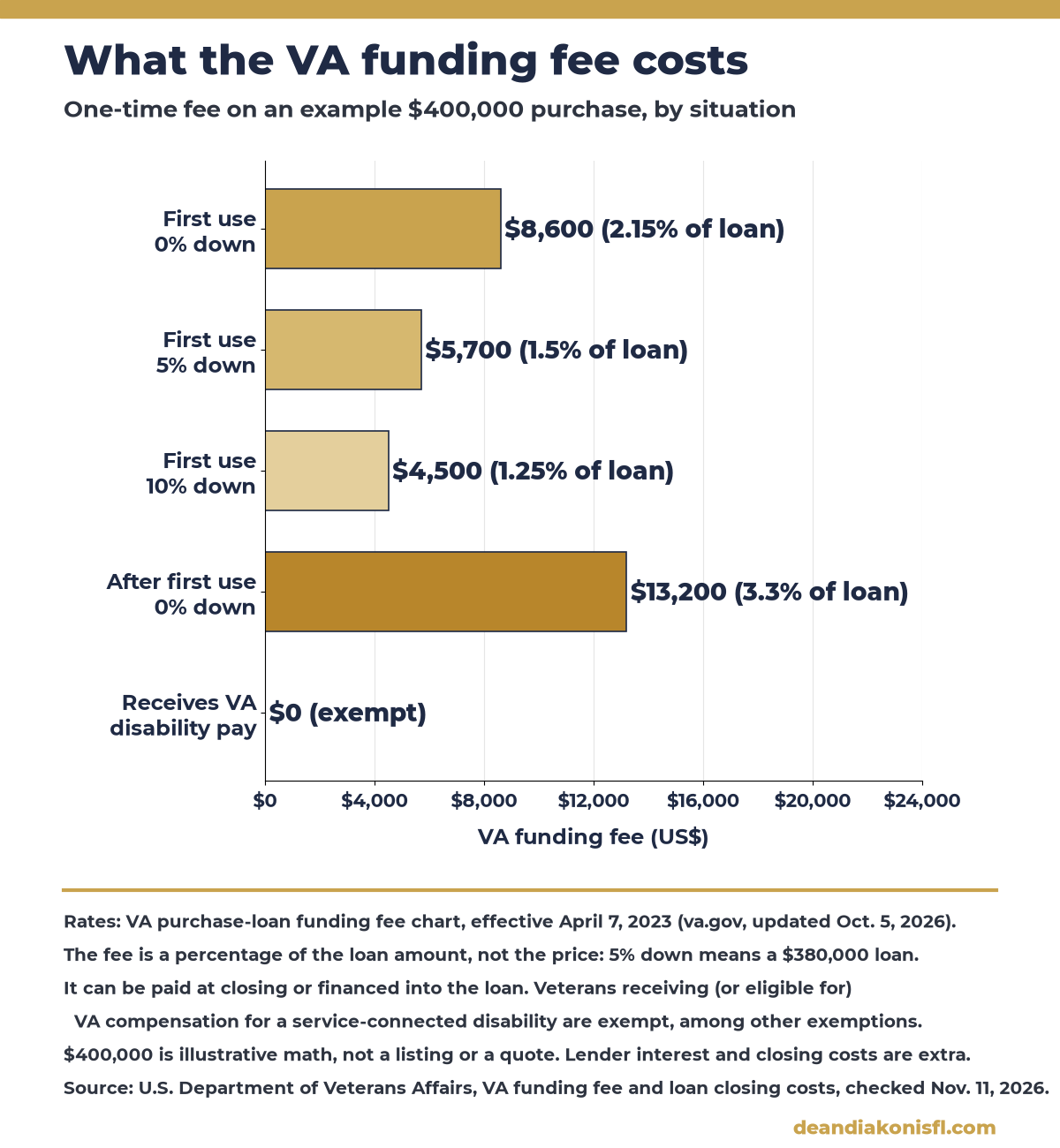
VA purchase-loan funding fee rates (effective April 7, 2023) applied to an illustrative $400,000 purchase, not a quote. Source: U.S. Department of Veterans Affairs, checked Nov. 11, 2026.
The big one people miss: veterans who receive VA compensation for a service-connected disability (or are eligible for it but receive retirement or active-duty pay instead) don't pay the funding fee at all. Surviving spouses receiving Dependency and Indemnity Compensation, and active-duty Purple Heart recipients who document it by closing, are exempt too. If a disability rating is later awarded retroactive to before your closing date, the VA says you may be eligible for a refund.
3. Sellers can help, up to a point
Buyers and sellers can negotiate who pays most closing costs. The VA doesn't cap seller credits for normal closing costs, but it limits seller concessions (things like paying your funding fee, paying off a debt, or prepaying your insurance) to 4% of the home's reasonable value on the VA Notice of Value. On a $400,000 reasonable value, that's up to $16,000 in concessions.
One detail that catches people: on a VA purchase loan, the funding fee is the only cost you can finance. Everything else has to be paid at closing, by you or through credits. That's why seller credits are worth deciding on before you write a VA offer, not after. Earlier this month I wrote about price cuts outrunning new listings in Tampa Bay, which is the kind of market where asking for credits is a reasonable conversation.
4. Condos have to be VA approved
A VA loan can buy a condo only if it is in a VA-approved project. With the number of condo buildings around Tampa Bay, check this before you fall in love with a unit. The VA's condo report search lets you look up a building, and your lender can confirm its status.
5. The appraisal protects you, and it can change the deal
The most a VA loan will cover is the appraised value or the purchase price, whichever is lower. The VA's own example: a $400,000 contract on a home that appraises at $375,000 caps the loan at $375,000. The VA appraiser also checks the home against the VA's minimum property requirements for a safe, sound and sanitary home. On older Tampa Bay homes, plan for that alongside your own inspection and the insurance side. My post on the four-point inspection covers the roof, plumbing, electrical and HVAC issues that tend to come up.
6. A VA loan can be assumed
VA loans are assumable, which means a buyer can take over the seller's existing loan instead of starting a new one. The VA funding fee on an assumption is 0.5%. If you're selling a home with an older, lower-rate VA loan, that can be a real selling point. If you're the veteran seller, ask your lender how an assumption affects your entitlement before you agree to one.
7. Don't skip the Florida property tax benefits
Florida has several property tax benefits for veterans and service members, summarized in the Department of Revenue's brochure PT-109 (revised October 2026):
- A $5,000 reduction in assessed value for honorably discharged Florida residents with a disability of 10% or more from wartime service or misfortune.
- A total exemption from property taxes on the homestead for honorably discharged Florida residents with a service-connected total and permanent disability.
- A discount for qualifying veterans 65 or older with a permanent service-connected disability, equal to their disability percentage.
- An exemption tied to qualifying deployments outside the continental U.S., Alaska and Hawaii in the previous year.
- Active-duty members can rent out their homestead without giving up the homestead exemption.
Eligibility rules are specific, so apply through your county property appraiser: Hillsborough, Pinellas or Pasco. Under Florida law, exemption applications are due by March 1 of the tax year, so if you buy this winter, put that date on your calendar. (Pinellas' property appraiser notes its offices are closed today for Veterans Day.) For the bigger homestead picture, see my posts on Amendment 3 and this year's property tax bills.
Where to start
- Get your Certificate of Eligibility. The VA explains how to request a COE, and many lenders can pull it for you.
- Talk to more than one lender. The VA doesn't set a minimum credit score, but many lenders do, and rates and fees vary. Compare the Loan Estimates line by line.
- Run the payment. Use my mortgage calculator, and remember Florida insurance and property taxes are a big part of the monthly number.
- Plan the offer. Decide early whether you're asking for seller credits, and check condo approval before you write an offer on a unit. My buyer's guide walks through the rest of the process.
To everyone who served: thank you. If you're thinking about using your benefit in Tampa Bay, I'm glad to walk through the numbers on a specific home with you and your lender.
This article is general information, not legal, tax or lending advice. VA fees, eligibility and Florida exemption rules come from the official sources linked above as of November 11, 2026, and can change. Confirm your own situation with your lender, the VA and your county property appraiser.