Florida voters just approved Amendment 3, and the Florida Department of Revenue has already issued its first implementation bulletin. If you own a home in Tampa Bay — or you're thinking about buying one — the change is real, but it is not a flat "property taxes go away" story. Here is what the amendment actually does, when it starts, and who gets which piece.
What passed
On Nov. 3, 2026, voters approved Constitutional Amendment 3 (House Joint Resolution 1-F). The Florida Department of Revenue Property Tax Oversight bulletin PTO 26-21 (dated Nov. 5, 2026) confirms the amendment:
- Increases the homestead exemption for non-school taxes to assessed value up to $150,000 in 2027 and up to $250,000 in 2028, then adjusts for inflation
- Leaves the school-district homestead exemption at up to $25,000
- Lowers the annual assessment-increase cap for non-homestead property from 10% to 5%
- Gives people who were not Florida residents as of Dec. 31, 2026 a smaller starting homestead exemption, with the larger exemption beginning in the fifth year of exemption
The amendment takes effect January 1, 2027, and first applies to the 2027 tax roll.
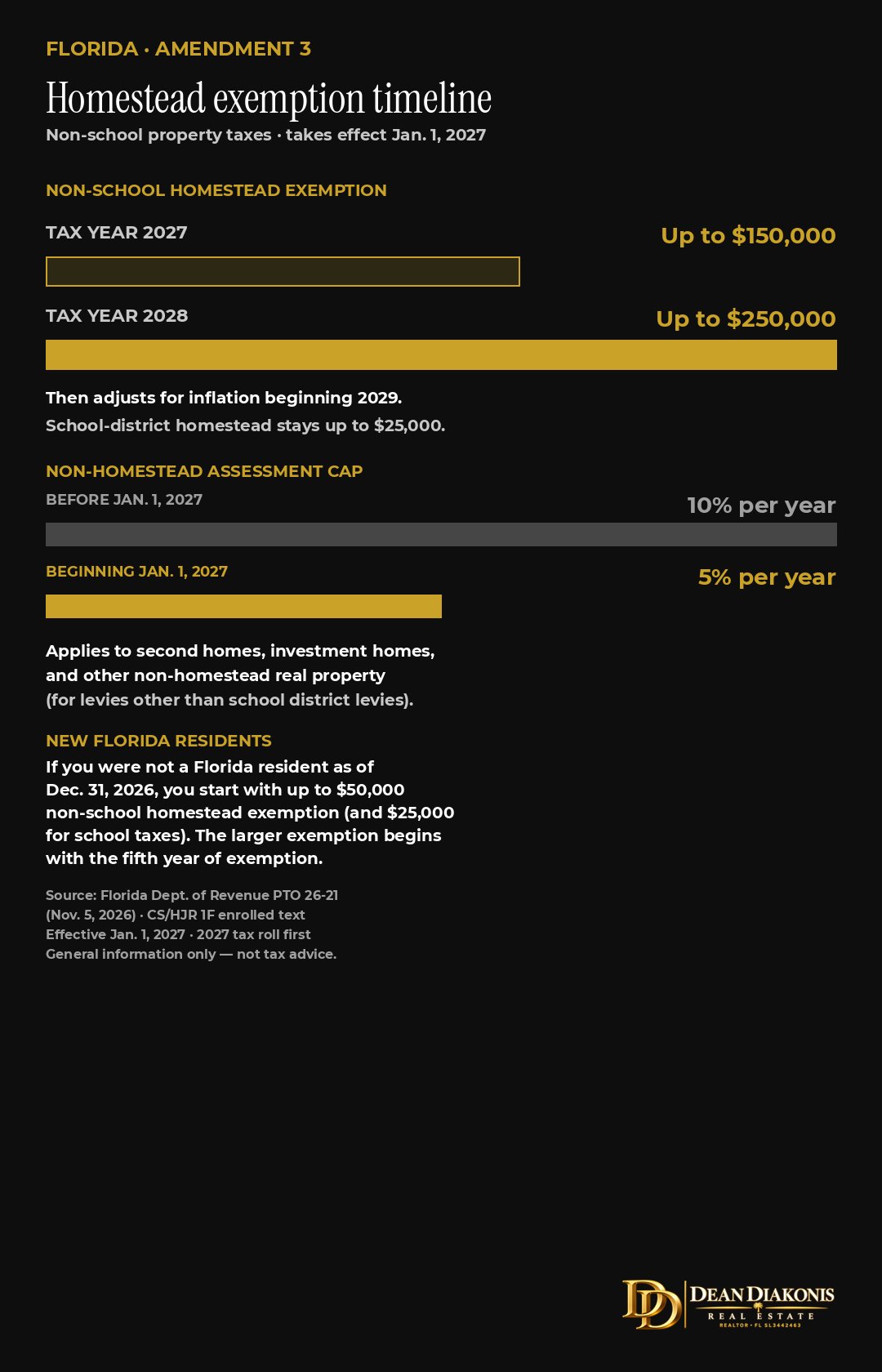
Florida Amendment 3 homestead and non-homestead changes from Florida Dept. of Revenue PTO 26-21 (Nov. 5, 2026) and the enrolled CS/HJR 1F text. General information only — not tax advice.
Florida Election Watch shows Amendment 3 at about 62% Yes statewide (above the 60% threshold constitutional amendments need). Hillsborough, Pinellas, Pasco, Manatee and Sarasota each recorded Yes majorities in that statewide tally. Treat election-night and canvassing figures as the Division of Elections updates them; the Department of Revenue bulletin is the clearest signal that implementation planning has started.
What this means if you homestead in Tampa Bay
If your Tampa Bay home is your permanent Florida residence and you qualify for homestead, the big change is the non-school exemption schedule above. County, city, and many other non-school levies are the ones that see the larger exemption. School taxes are not wiped out — the school-district homestead piece stays capped at up to $25,000 under the amendment text the Department of Revenue summarized.
Your actual bill still depends on assessed value, millage rates, and other exemptions you already have. Amendment 3 does not invent a single statewide dollar savings for every house in Tampa, St. Pete, or Clearwater. It changes the exemption and assessment rules; your county property appraiser and tax collector apply those rules to your parcel.
Save Our Homes (the homestead assessment-increase limit of 3% or CPI, whichever is lower) is a separate constitutional rule. Amendment 3's headline pieces are the larger non-school homestead exemption and the tighter non-homestead assessment cap — not a rewrite of Save Our Homes itself.
What this means for second homes and investors
If you own a second home, snowbird place, or investment property that does not qualify for homestead, the change that matters most is the non-homestead assessment cap: annual assessed-value increases for those properties (for levies other than school district levies) drop from a 10% ceiling to a 5% ceiling beginning Jan. 1, 2027.
That does not freeze your tax bill. Assessed value can still rise each year up to the new cap (and cannot exceed just value). After a change of ownership or control, non-homestead property is generally reassessed at just value under the rules the constitution and statutes set. If you are weighing a second home near the Sunshine Skyway, downtown St. Pete, or elsewhere in the Bay, factor the new cap into long-term ownership cost — and verify homestead status carefully before you assume you get the larger exemption.
The five-year rule for new Florida residents
Amendment 3 draws a bright line at Dec. 31, 2026. People who were not Florida residents on that date, and who later qualify for homestead, start with:
- Up to $25,000 exemption for school taxes
- Up to $50,000 exemption for non-school taxes
Eligibility for the increased homestead exemption begins with the fifth year of exemption. If you are relocating to Tampa Bay from up north in 2027 or later, that timing matters for budget planning. Permanent residency and homestead applications still run through your county property appraiser — this amendment does not replace those filing rules.
What to do next (without guessing your bill)
- Confirm whether your property is homesteaded with your county property appraiser (Hillsborough, Pinellas, Pasco, Manatee, or Sarasota, depending on where you live).
- Read the Department of Revenue bulletin and watch for follow-up guidance on forms and rulemaking.
- If you are buying or selling, treat tax estimates as estimates until the 2027 roll is built — do not price a listing or an offer off a viral "tax cut" graphic.
If you want a current read on your home's market value while the tax rules catch up, start with a home valuation. Selling? See how I work with sellers. Shopping the Bay? Browse homes for sale.
This article summarizes publicly available Florida Department of Revenue and legislative materials. It is general market and civic information for Tampa Bay readers, not legal, tax, or accounting advice for any property or person. Confirm details with your county property appraiser, tax collector, or a qualified tax professional before you make decisions.